
Objectives
- Thoughts interpret our physiology and are driven by it. Stress physiology creates unpleasant thoughts.
- Modern self-help processess are ineffective because thoughts cannot be controlled or reasoned with.
- By calming down and nurturing safety physiology, your body heals on its own.
- Quit fighting your thoughts, and nurture joy. Like the caterpillar, you will wonderfully emerge.
The harder you fight your unwanted thoughts, the louder they get. Neuroscience shows us alternatives.
Let your body do what it knows how to do – heal.
Benoit Denizet-Lewis1 recently ended a New York Times essay on self-transformation with a cartoon: a butterfly peering down at a caterpillar, dispensing advice with the easy authority of someone who has only recently sprouted wings. “The thing is,” the butterfly says, “you have to really want to change.” This makes no sense. No one wants to suffer, but either they are so beaten down that they can’t change, or they lack the skills.
The irony, as Denizet-Lewis points out, is obvious. The caterpillar’s transformation has nothing to do with wanting. It becomes what it becomes. Another way to say it is that your body knows how to heal if you can learn to get out of the way.

Rabbiti/AdobeStock
After more than three decades as a spine surgeon, I have watched this same paradox destroy people’s chances of getting better. Not because they didn’t try hard enough — but because they tried too hard in exactly the wrong direction.
The Invisible Trap
Most people I see with chronic mental and physical pain are fighters. They are not passive; they analyze their thoughts, suppress the worst ones, read every book, and try every modality. They do everything the self-improvement industry tells them to do — and they get worse. During the darkest phase of my personal ordeal with pain, I was an “epiphany addict” and on a relentless search for an answer. Only after I was completely broken to the point of suicide did I let go, and I began to heal. You don’t have to endure this level of suffering to transform, and I have witnessed hundreds of patients experience deep healing, with much less angst. This is not a mystery; it is a physiological mechanism. Your body breaks down under sustained stress and regenerates when it feels safe. Constantly searching for a fix and being disappointed doesn’t make you feel safe.
Research consistently shows that pursuing happiness produces sadness.2 The more deliberately we chase a positive state, the more the brain scans for the gap between where we are and where we want to be. That scanning is a threat signal. And a nervous system locked in a state of threat cannot heal.
The self-help industry rests on the premise that transformation is a product of will — that with the right techniques, enough effort, and sufficient self-awareness, you can think your way to a better life. But this premise misunderstands the most basic fact of human biology: your body is not waiting for your permission to heal. It is waiting for safety.
The Hornets’ Nest
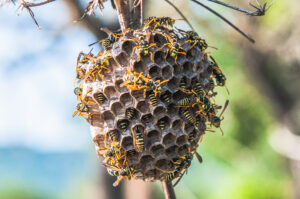
Think of your brain and nervous system as a hornet’s nest.
The anxiety, anger, shame spirals, and repetitive unwanted thoughts that keep you awake at 3 a.m. — what I call RUTs, or Repetitive Unwanted Thoughts — are the hornets. They are automatic survival signals generated by your nervous system, doing exactly what it was designed to do: alert you to a threat.
The problem begins when you treat these signals as the problem. Every attempt to suppress, analyze, argue with, or medicate those thoughts sets the hornets off. The hornets become more agitated and swarm. The nervous system registers the reaction as a new threat, generating additional signals that provoke further responses. Talk therapy rehearses the content of unpleasant thoughts. Interventions that urge the hornets to calm down and go back into the nest won’t work. The real answer lies in not continuing to shake the nest. Then the hornets can quiet down and re-enter their home.
Well-meaning, conscientious people often struggle more with RUTs than others. They care deeply about being well, so they fight harder when the alarm sounds. But fighting the alarm is not the same as addressing the fire.
cristian/AdobeStock
What the Body Already Knows
From over 15 years spent in the abyss of anxiety, anger, and severe obsessive thinking, I learned that your body (including your brain) already knows how to heal. It always has. The human organism regenerates and repairs constantly — but only when it is in a state of safety long enough to do so. There is always some degree of remaining on alert.
Stephen Porges, the author of Polyvagal Theory, calls these reactions “neuroception” — the nervous system’s continuous, largely unconscious scan of the environment for cues of danger or safety.3 When neuroception detects a threat, the body mobilizes. Stress hormones and inflammatory molecules flood the system, raising inflammation. The thinking brain narrows. This is threat physiology — and it is incompatible with healing.
When neuroception registers safety, the opposite occurs. Defensive tone subsides. Blood flows back to the prefrontal cortex. Neuroplasticity — the brain’s capacity to physically rewire itself — becomes possible. Healing happens then: not as an act of will, but as an emergence. The body does what it was always capable of once exposed to the right conditions.
I watched this in my clinic. Patients who had been in intractable pain for years, who had tried every intervention, would often become symptom-free — not after a new surgery or a better medication, but after learning to stop generating threat signals and engendering cues of safety. In the most practical sense, they stopped shaking the nest.
From Reactive to Creative
The shift required is not passive. It is not resignation. It is something more precise: redirecting attention away from the problem and toward the life you want.
Neuroplasticity works in both directions. Your brain develops where your attention goes. If your attention is on the symptoms — analyzing, fearing, and fighting them — your neural circuitry deepens around them. The RUTs get deeper.
But when you deliberately choose connection, curiosity, creativity, and joy, new circuits form. The old reactive pathways atrophy from disuse. This is not positive thinking. It is biology. The brain you have tomorrow is shaped by where you place your attention today. It is formed by repeatedly making positive choices. This concept has existed for millennia. Stoic thinking from 2000 years ago is an example.4
Notice what this means in practice: healing is not a subtraction. You do not get better by removing the bad. You heal by building something else — and by allowing the nervous system to slowly and repeatedly register that the nest is no longer being shaken.
The caterpillar’s lesson
The caterpillar does not think its way into becoming a butterfly. It does not try harder. It does not attend more workshops or optimize its transformation strategy. It surrenders to a process already underway — one that was always going to happen under the right conditions.
This is what I want patients to understand, and what the self-improvement industry cannot afford to tell them: you cannot fix yourself. But you can create the conditions for your body to heal.
Let’s wake up! Give up fighting the darkness and turn on the lights. The caterpillar becomes what it will become depending on the dominant state of threat or safety. You must learn to find the switch.
David Hanscom, MD, is a retired spine surgeon and the author of Calm Your Body, Heal Your Mind: Transcend Pain, Anxiety, Anger, and Repetitive Unwanted Thoughts (Chelsea Green, June 2026).
References
- Denizet-Lewis, Benoit, “Change Doesn’t Happen the Way You Think.” New York Times, April 5th, 2026.
- Wegner, Daniel. “The Seed of Our Undoing.” Psychological Science Agenda, (1999); pp 10-11.
- Stephen W. Porges, “The Polyvagal Theory: Phylogenetic Substrates of a Social Nervous System,” International Journal of Psychophysiology 42, no. 2 (2001): 123–46, https://doi.org/10.1016/S0167-8760(01)00162-3.
- Epictetus and Sharon Lebell. The Art of Living. HarperOne (2007); New York, NY.